

Not long ago, I brought a small gold company to your attention — one that, in my view, could be sitting on what may become a meaningful high-grade gold discovery here in the lower 48.
The drills have kept turning since then.
And earlier today, the company put out an announcement worth paying attention to.
It's the kind of result almost any gold company would want to see.
I'll get to it shortly.
But first, some context on why it matters — and why I'd argue the timing is favorable.
Because while this small company was busy pulling high-grade gold out of the Arizona desert, some of the largest buyers in the world were sending a signal that, in my view, the mainstream press largely overlooked.
Let me walk through it.
The Buyers Who Rarely Sell Are Leaning In
Last week, the World Gold Council put out its 2026 Central Bank Gold Reserves Survey.
Tucked inside was a figure I think deserved far more attention than it got.
A record 45% of the world's central banks say they intend to add to their own gold reserves over the coming year.
89% expect total central bank gold holdings to keep rising.
And reportedly, not one central bank surveyed said it plans to sell.
Consider who these institutions are.
They're among the most cautious and powerful financial actors anywhere. As a rule, they don't chase fads or short-term trades — their job is to safeguard nations.
And right now, collectively, they appear to be tilting in the same direction at the same time — toward gold, and away from the dollar.
By some measures, gold has now quietly passed U.S. Treasuries to become the single largest reserve asset in the world.
That, I'd argue, is a notable shift.
For 80 years, the asset treated as "risk-free" was U.S. government debt. Now, one sovereign after another seems to be recognizing that "risk-free" carries a caveat — particularly when the party that issues the asset can freeze it with a single decision.
It's the same thread I traced in an earlier letter: BRICS nations assembling a parallel settlement framework, Washington formally placing gold on its critical minerals list, and the slow, deliberate erosion of the dollar's status as the world's reserve currency.
My suggestion is to think of gold less as a trade and more as a long-term re-pricing of the world's oldest form of money.
And I don't think Wall Street is unaware of this.
JPMorgan has reportedly floated a $6,300 gold target, and some analysts have gone as far as $7,000.
Yes, gold slipped last week — back toward roughly $4,150 on a more hawkish Fed and cooling tensions in the Middle East.
But it helps to zoom out.
In my lifetime, gold pushed past $1,000, then $2,000, then $3,000 — each step taking years.
Then, within a span of months, it broke through $5,000 to a record near $5,600 this past January.
In my view, every dip along that path turned out to be a buying opportunity.
And here's a dynamic worth understanding about a rising gold price: when gold climbs like this, a small number of companies — holding the right ground, in the right jurisdiction, at the right moment — can become acquisition targets.
We've seen that pattern repeat with companies featured in the Equedia Letter.
The smaller vessels tend to rise fastest.
Today, I want to point you toward one I believe is well-positioned.
West Point Gold Corp.
(Original report here: "By the Time You Read This, They've Already Bought More.")
For anyone just tuning in, here's the short version.
West Point Gold Corp.'s (WPG:TSXV; WPGCF:OTCQX; LRA0:FSE) flagship is the Gold Chain Project, a large low-sulphidation epithermal gold system spread across roughly 11,760 acres of patented and BLM land in the historic Oatman District of northwestern Arizona.
It lies along the southern extension of the well-known Walker Lane Trend — the same geological corridor that hosted Round Mountain (more than 20 million ounces) and the Bullfrog district, which AngloGold Ashanti Ltd. (AU:NYSE; ANG:JSE; AGG:ASX; AGD:LSE) has spent years and well over half a billion dollars consolidating.
The project holds water rights on its own patented land — a rare and essential ingredient for any mine.
VanEck, the world's largest gold ETF manager, sits on its share register.
Kinross Gold Corp. (K:TSX; KGC:NYSE), a senior global producer, holds a strategic option arrangement on one of the company's Nevada assets.
And the management team has built and sold mining companies to major producers before.
But none of that is the reason for today's letter.
I'm writing because of what West Point Gold just disclosed.
Why This Result Stands Out
First, a brief geology primer, since it's central to the story.
Most low-sulphidation epithermal gold systems — the type West Point Gold is drilling — tend to run out of steam at around 300 meters of vertical depth.
Maybe 400m on a strong day.
Below that, they usually narrow, thin out, and fade.
So the key question for a deposit like this is straightforward:
Does the high-grade material continue at depth?
When an epithermal system keeps improving as you go deeper rather than fading, geologists have a specific term for it.
They call it telescoping.
It's the signature of a fundamentally larger, less common, and more valuable system underneath.
That's the distinction between a respectable discovery and a potential company-maker.
Now, West Point Gold's Tyro Main zone is already a solid discovery on its own, and Tyro NE was already a high-grade system.
Drilling at Tyro NE has repeatedly returned meaningful high-grade gold.
Just last month, the company reported on two holes, GC26-134 and GC26-137:
- Hole GC26-134 returned 19.7m of 9.06 g/t Au from 95.8 to 115.5m, roughly 20m above GC25-059 (15.3m of 7.02 g/t Au).
- Hole GC26-137 returned 35.7m of 3.2 g/t Au from 53.2 to 88.9m, including 10.2m of 10.23 g/t Au, roughly 20m above GC25-047 (38.1m of 4.86 g/t Au including 10.7m at 8.64 g/t Au).
According to the company, these results both confirm the high-grade discoveries logged in drill core at the NE Tyro Zone and match or exceed many earlier results, reinforcing the substantial widths and high-grade character of the system at NE Tyro.
Even so, despite being an established high-grade zone with consistent results, West Point Gold had never drilled below 250m at Tyro NE.
Management believes there is considerably more to find, so they deliberately aimed beneath their prior drilling at Tyro NE — around 250 meters below surface.
And they didn't just graze the edge.
By their account, they drilled into the center of it.
Today, the company released results for the GC26-148 drill hole — and by its description, it's a strong one.
Here's the headline:
- 66.2 meters of 6.57 g/t gold from 219 meters
- Including 20.7 meters at 18.25 g/t — a thick, high-grade core
Management describes it as among the widest (true width) and highest-grade intercepts ever drilled at the Northeast Tyro zone.
For perspective, those internal grades are roughly 35 times the average grade of an open-pit gold mine in the southwestern United States.
And here's the piece I think the market may not have fully absorbed yet.
This hole extended the high-grade zone to more than 250 meters below surface — and the company now says the zone is likely to remain open at depth even after its upcoming maiden resource estimate.
Put simply: when the maiden resource arrives — the first formal tally of ounces — it almost certainly won't capture the full scale of the system.
There would be a known, drilled, high-grade extension sitting below the resource boundary.
What the Geology Appears to Be Saying
If you pull up the company's news release, the technical summary can read like another language for anyone outside of geology.
Most readers will skim past terms like "crustiform-banded adularia," "phreatic breccia," and "bladed calcite lattice texture."
But within that jargon, I'd argue, sits the actual story — because those dry-sounding details are exactly what an experienced exploration geologist looks for.
So let me translate, paragraph by paragraph, in plain language. Bear with me — this is where you start reading the signals the professionals read.
What they reported: The intercept is a broad zone of quartz veinlets, stockwork, and vein breccia spanning 66.2m, with an estimated true width of about 35m, and it appears to extend a steeply plunging "shoot."
What it means: Picture gold mineralization as a plumbing network. Hot, gold-rich fluids rose through fractures in the rock millions of years ago and shed their gold as they cooled. A "shoot" is an especially rich, concentrated channel of that gold, the thick part of the plumbing. Hitting a steeply plunging shoot means they didn't just clip a thin vein; they drilled into a thick, near-vertical column of gold dropping down into the earth. And a "true width of about 35m" matters a great deal: plenty of drill results look impressive until you realize the drill struck the vein at an angle, which inflates the figure. Here, even after adjusting for that angle, this is a genuinely wide body of gold. Wide, combined with high-grade, is the pairing you want.
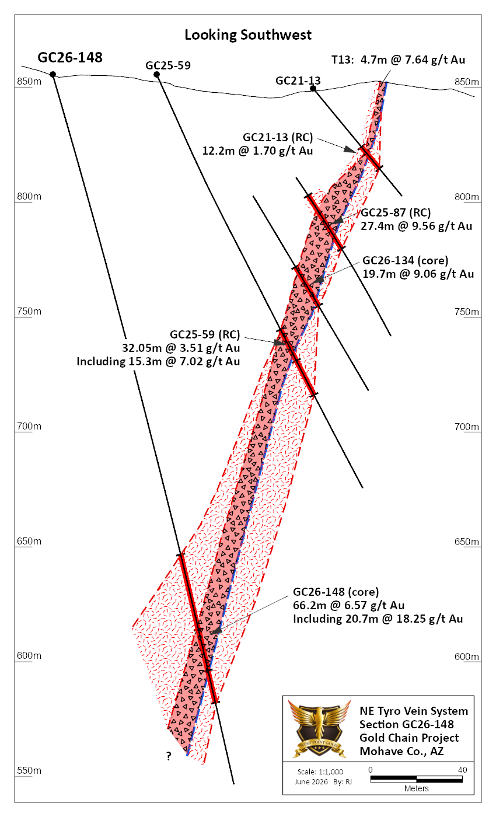
What they reported: The NE Tyro vein is described as a robust, uniform system that dips consistently and ranges from 10m to 35m wide, hosted in Precambrian granite.
What it means: "Robust and uniform" is geologist shorthand for predictable. And predictable carries real value. Many gold veins are unruly — they pinch, swell, twist, and disappear, which makes them difficult and costly to drill out and mine. A vein that holds a steady width and direction over a long stretch is cheaper to define, easier to model into a resource, and more likely to become an actual mine. Predictability tends to earn a premium.
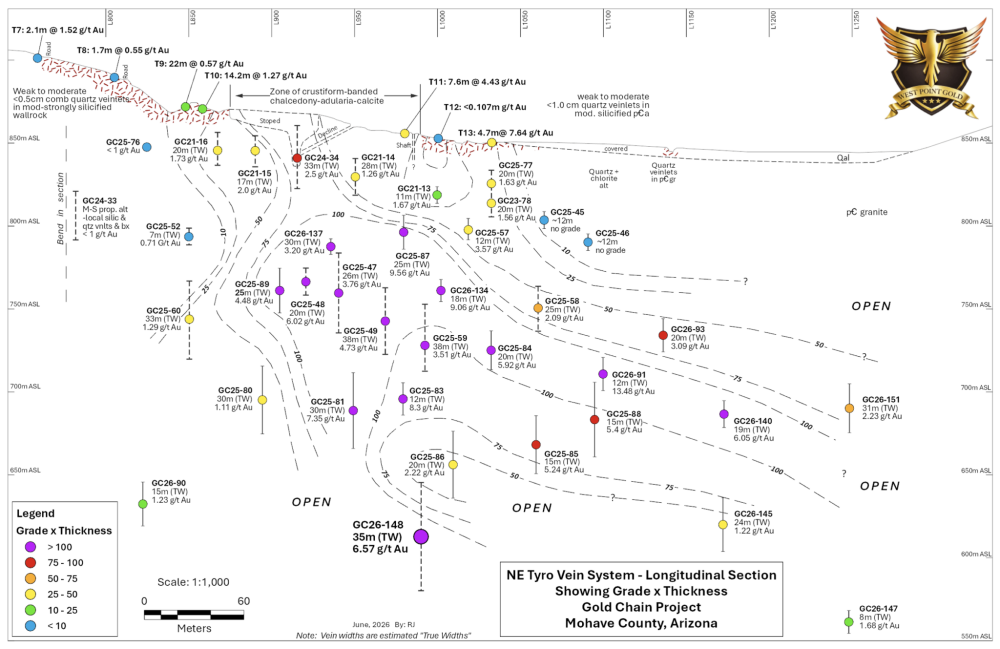
What they reported: The mineralized zone is a multi-stage breccia cemented by several "crustiform-banded" stages of quartz-calcite-adularia, and one sample returned 1.73m at 62.7 g/t.
What it means: "Crustiform banding" describes gold-bearing minerals laid down in layers — like rings in a tree — one event stacked over the next. "Multi-stage" means the system didn't fill with gold a single time; it was recharged and refilled repeatedly, with each pulse of fluid adding more gold. That's a marker of a large, long-lived, healthy mineralizing system rather than a brief, one-time event. And "adularia"? That specific mineral is a textbook fingerprint telling geologists the fluids were boiling — precisely when gold drops out of solution and concentrates. Spotting adularia is a bit like a cook seeing the water reach a rolling boil: it signals the conditions are just right.
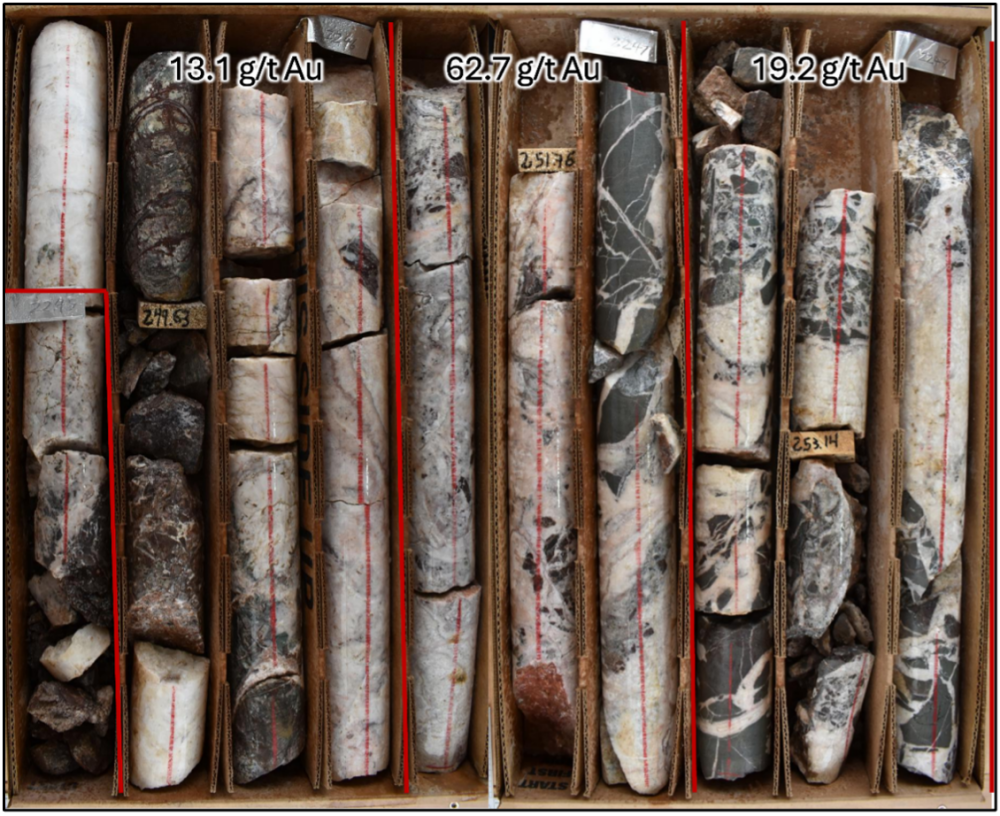
What they reported: The footwall contains hydrothermal and possibly "phreatic breccia" with fluidal "streaming" textures, which the company suggests points to recurrent movement and explosive events tied to deeper fluid boiling and potential gold deposition.
What it means: "Breccia" is rock shattered into fragments and re-cemented. "Phreatic breccia" with fluidal, streaming textures indicates underground steam explosions — violent, high-energy events in which pressurized, gold-rich fluids blasted through the rock. Why does that matter? Because those explosions occur above the boiling zone — and the boiling zone is where the gold forms. In effect, the rock is telling the geologists that the engine that produced this gold likely sits somewhere below where they've drilled. They're seeing the smoke; the fire is deeper.
What they reported: "Bladed calcite lattice texture" has developed, and native gold has been observed in dendritic growths.
What it means: Two more confirmations. "Bladed calcite lattice texture" is one of the more reliable visual indicators that a system was boiling — geologists treat it as a field flag for "drill here." And native gold observed means they can actually see gold in the rock, not just gold flagged by a lab assay. When you can spot boiling textures in the hole, you're in the heart of an epithermal system.
So, taken together:
A wide, predictable, high-grade shoot that plunges downward, in a system that is filled with gold repeatedly, displaying nearly every textbook sign that the gold-forming engine still sits below the drilled depth.
In other words, the rocks themselves seem to be pointing down and saying, "Keep going."
That, in my reading, is nature's hint that there's more — even after West Point Gold's maiden resource is published.
As I noted in the earlier letter:
"…The corp-dev teams at the big gold producers such as Newmont, Kinross, Barrick and AngloGold are all hunting for the same checklist: 100,000 to 300,000 ounces a year of potential, first-quartile cash costs, a Tier-1 jurisdiction, and exploration upside. WPG already checks every one of those boxes."
In short, if West Point Gold delivers what management has been signaling — a resource of roughly 2 million ounces at around 2 g/t, plus a high-grade extension zone not included in that resource — I'd expect the major producers to take notice.
By the company's framing, its gold project is shaping up into what major producers tend to seek: open at depth, high grades, and a low-sulphidation epithermal system in a tier-1 jurisdiction.
And there's a reasonable chance hole GC26-148 isn't a one-off.
Seven more holes still have assays pending at this same depth at Northeast Tyro, part of roughly 6,550 meters of assays still to come.
As President & CEO Derek Macpherson framed it, the high grades at NE Tyro continue at depth, the zone is expected to remain open following the maiden resource, and deeper drilling is set to resume under a funded program running from Fall 2026 into Spring 2027.
A Comparable Story From the Past
You might be thinking: "That's a good hole, but how do I know it leads anywhere?"
Reasonable question.
So let me lay out the template, because we've seen a version of this before.
In the prior report on West Point Gold, I drew a parallel to a company called Corvus Gold.
Longtime readers will recall it.
Corvus's North Bullfrog project sat along the same Walker Lane Trend. It hosted the same style of low-sulphidation epithermal gold — high-grade vein and stockwork zones wrapped in lower-grade halos.
Familiar?
It should be. It's essentially the deposit architecture West Point Gold is drilling at Tyro right now.
And here's how the Corvus story concluded.
In 2022, AngloGold Ashanti stepped in and acquired Corvus for a total equity value of US$450 million.
That transaction became the foundation of what AngloGold now describes as a Tier-1 gold district — a mine projected to produce an average of 105,000 ounces of gold per year over an 11-year life.
But there's a further twist.
After acquiring Corvus, AngloGold's geologists continued drilling the district and went on to define a deposit called Merlin, whose mineralization reaches unusual depth for an epithermal system.
And who was the Exploration Manager at Corvus through the AngloGold takeover?
A 40-year Walker Lane veteran named Mark Reischman.
Where is Mark Reischman now?
He came out of retirement to advise West Point Gold on its deep-target thesis at Gold Chain.
By his own account, he didn't return for an easy paycheck.
He returned because he's seen this configuration before and believes he knows what lies beneath it.
So when I say a hole demonstrating that West Point's high-grade continues at depth is significant, here's the context:
Same trend, same deposit type, and the same lineage of people who turned Corvus into a US$450 million acquisition — except this time with gold trading at more than double the price it was when Corvus was bought.
Analysts Are Starting to Take Note
Here's one reason I think the market hasn't fully caught up.
On June 14, 2026, Paradigm Capital began research coverage on West Point Gold.
Their rating: Speculative Buy.
Their 12-month target: CA$3.30 per share.
At the time, the stock was trading around CA$1.10.
That implies a potential return north of 200% to their target.
And this wasn't a quick estimate.
Paradigm spent six months working with an independent resource estimator and toured the project in person. Their conclusion, per that report:
There is already a real, economic deposit here, even before the company has published its first official resource.
Their figures:
- Paradigm independently estimates that the two Tyro zones already host roughly 1.1 million ounces at 2.1 g/t, including the high-grade NE Tyro zone at about 0.6 million ounces at 3.5 g/t.
- They ran a conceptual mine model that generates a 54% after-tax IRR and a net present value of roughly US$1.09 billion at $4,500 gold…
- …against a company carrying a market cap of only about US$107 million when they wrote it.
- Their net asset value works out to CA$9.65 per share at $4,500 gold, meaning that at CA$1.10, the stock was trading at barely 0.11 times its own NAV.
Now tie that back to hole GC26-148.
Paradigm's model specifically highlights the extension of NE Tyro at depth as a key catalyst. They estimate that every additional 100 meters of NE Tyro extension is worth roughly 70,000 ounces — and that adding just 0.2 Moz to the high-grade zone alone would raise their NAV by about 20%.
GC26-148 is part of that extension — and it returned even higher grades.
They also note that both Tyro zones are "open at depth," which is exactly what the new hole appears to confirm for NE Tyro.
So, Why Has the Stock Pulled Back?
Some of you are looking at the chart and asking the obvious question.
If the story is this compelling, why is the stock down from its highs?
Fair. Here's my straight answer.
As regular readers know, we share ideas based on a company's long-term merits, not on short-term price swings.
Take our last antimony idea. We first featured it at CA$0.50. We featured it again when it dropped below CA$0.36.
Last month, it traded above CA$3.
The climb, in other words, wasn't a straight line. But we stayed with it on the project's merits — not on day-to-day price action.
I'd argue West Point Gold is in a comparable spot.
Some of the recent weakness simply tracks gold's price. The whole sector pulled back as gold came off its highs, and juniors tend to move more sharply than the metal itself. That's typical.
But there's a second, more mechanical factor that has nothing to do with the quality of the rock.
It's the warrant and financing overhang.
Per WPG's disclosure, the company has just over 20 million warrants outstanding, with an aggregate exercise value of roughly CA$9.9 million — plus a recent private placement that has now become free-trading, adding more stock to the float.
When a stock carries a sizable block of in-the-money warrants, that can act like a ceiling.
As the share price rises, warrant holders have an incentive to exercise and sell into strength. That selling can weigh on the share price, especially near resistance. New shares enter the float as existing holders are diluted.
Anyone who has followed junior miners long enough has watched this play out.
There's a timing element too: roughly 60% of those warrants expire in 2026.
Holders facing expiry have a forcing decision: exercise or forfeit the option entirely.
That can concentrate a wave of selling into a narrower window.
So yes, I believe that's part of why the stock has been soft.
But here's where it gets interesting.
A Feature, Not a Bug
That same overhang that looks like a drag on a quiet day can look very different on a catalyst day.
When WPG shares reached CA$2.17 back in February 2026 on the back of strong drill results, the very same warrant structure was already in place.
The market pushed straight through the overhang.
Why? In my view, the news was strong enough.
When a company is approaching a maiden resource, with a backlog of pending assays and continued high-grade hits, catalyst flow can overwhelm supply pressure.
And WPG has a queue of catalysts ahead.
Now consider what those warrants would actually represent if exercised.
That CA$9.9 million in exercise value is, in effect, a pre-funded treasury.
If those warrants come in, that's roughly CA$10 million in cash flowing directly into West Point's bank account — with no brokered financing, no marketed deal, and no dumping of new shares at a discount to market.
For a junior explorer about to ramp up drilling and head toward a maiden resource, about CA$10 million of capital is meaningful.
And here's the last piece.
The strike prices themselves help anchor a floor under the stock.
Warrant holders sitting on paper struck at CA$0.30 to CA$0.45 are unlikely to dump everything the moment the stock ticks up. They're already up three or four times their money — and were up considerably more when shares were around CA$2.
Many of these holders are insiders, family, friends, and supportive institutions who got in early.
In short, they have a stake in the longer-term story.
So while the overhang explains some of the recent softness, I'd argue it's set up to turn into a tailwind once the catalysts land.
A cheaper entry point, a built-in treasury, and a floor under the stock — all heading into a maiden resource.
That, in my opinion, is an opportunity.
The Wider District Picture
And Tyro is only one part of the story.
Beyond the two Tyro zones, West Point Gold is already chasing gold at three additional targets across the property:
- Black Dyke — a wide-open structural setting with historic mining and gold at surface.
- Sheep Trail — which returned 32.0 meters of 1.0 g/t gold in April, opening a third potential resource area on the same property.
- Bull 8 — which returned 21.4 meters of 1.0 g/t gold in early June, on the first-ever drilling along a 12-kilometer untested structural corridor.
Looming over all of it is the Frisco Graben — a large, covered target that West Point's 2025 drilling already indicated sits above a productive epithermal system.
The Frisco Graben is the target Mark Reischman identified on this property from day one.
It's the reason he came out of retirement to advise West Point Gold.
Paradigm believes the planned 2026–2027 drill program could point to property-wide potential of 2 million ounces or more.
In other words, the market right now appears to be pricing in only the first zone.
It hasn't yet begun to factor in the district.
Conclusion
So let's bring the whole picture together.
- Gold above $4,100, central banks buying at a record pace, and Washington treating domestic gold as a national-security matter.
- A high-grade gold system on patented ground, with water rights, in a tier-1 mining jurisdiction.
- 66.2m of 6.57 g/t, including 20.7m at 18.25 g/t — which, in the company's view, demonstrates that the high-grade continues at depth, more than 250 meters down, still open.
- Seven more holes are pending at that same depth.
- A maiden resource estimate due later this year — the single event that shifts a junior from "exploration story" to a figure a major can put a price on.
- An independent analyst target of CA$3.30 against a roughly CA$1.10 stock, with a modeled NAV of CA$9.65.
- A precedent — Corvus Gold — that played out 180 miles up the same trend and sold for US$450 million.
We've been at this long enough to believe that this kind of mathematical mispricing doesn't persist indefinitely.
Particularly not while the drill keeps hitting.
Show me another junior gold explorer with this kind of consistent high-grade drilling, in a low-sulphidation epithermal gold system, in a tier-1 jurisdiction, with water rights.
In my experience, when we've seen results approaching 66.2m of 6.57 g/t from a gold junior, those shares have moved sharply.
And more results are on the way.
The maiden resource is on the way.
The assays are still arriving.
And in the company's framing, the deeper they drill, the more compelling this becomes.
| Want to be the first to know about interesting Gold investment ideas? Sign up to receive the FREE Streetwise Reports' newsletter. | Subscribe |
Important Disclosures:
- As of the date of this article, officers, contractors, shareholders, and/or employees of Streetwise Reports LLC (including members of their household) own securities of West Point Gold Corp.
- Carlisle Kane: I, or members of my immediate household or family, own securities of: West Point Gold Corp. My company has a financial relationship with: West Point Gold Corp. My company has purchased stocks mentioned in this article for my management clients: None. I determined which companies would be included in this article based on my research and understanding of the sector.
- Statements and opinions expressed are the opinions of the author and not of Streetwise Reports, Street Smart, or their officers. The author is wholly responsible for the accuracy of the statements. Streetwise Reports was not paid by the author to publish or syndicate this article. Streetwise Reports requires contributing authors to disclose any shareholdings in, or economic relationships with, companies that they write about. Any disclosures from the author can be found below. Streetwise Reports relies upon the authors to accurately provide this information and Streetwise Reports has no means of verifying its accuracy.
- This article does not constitute investment advice and is not a solicitation for any investment. Streetwise Reports does not render general or specific investment advice and the information on Streetwise Reports should not be considered a recommendation to buy or sell any security. Each reader is encouraged to consult with his or her personal financial adviser and perform their own comprehensive investment research. By opening this page, each reader accepts and agrees to Streetwise Reports' terms of use and full legal disclaimer. Streetwise Reports does not endorse or recommend the business, products, services or securities of any company.
For additional disclosures, please click here.
Equedia Investment Research Disclosures
Equedia.com and Equedia Network Corporation are not registered as investment advisers, broker-dealers or other securities professionals with any financial or securities regulatory authority. Remember, past performance is not indicative of future performance. This article also contains forward-looking statements that are subject to risks and uncertainties that could cause actual results to differ materially from the forward-looking statements made in this article. Just because many of the companies in our previous Equedia Reports have done well, doesn’t mean they all will. We are biased towards Westpoint Gold (WPG) because the Company is an advertiser on www.equedia.com. We currently own shares of WPG. You can do the math. Our reputation is built upon the companies we feature. That is why we invest in every company we feature in our Equedia Special Report Editions. It’s your money to invest and we don’t share in your profits or your losses, so please take responsibility for doing your own due diligence and consult your own professional advisers before investing in WPG or trading in WPG securities. Any opinions expressed in this article are our own. We’re not obligated to write a report on any of our advertisers and we’re not obligated to talk about them just because they advertise with us. For a complete disclosure of the compensation received by us from WPG, please review our Terms of Service and full disclaimer at www.equedia.com/terms-of-use/. This newsletter (this “Newsletter”) is provided by Equedia Network Corporation (“Equedia”, “we” or “us”). Your access to and use of this Newsletter is subject to and governed by this disclaimer and Equedia’s Terms of Use, which is available at http://www.equedia.com/terms-of-use (the “Terms”). Please read this disclaimer and the Terms carefully. This Newsletter is not an offer to sell or a solicitation of an offer to buy any securities or commodities. To the extent that anything contained in this Newsletter may be deemed to be investment advice or a recommendation in connection with a particular company or security, such information is impersonal and is not tailored to the needs of any specific person. In addition to historical information, this Newsletter may contain forward-looking statements, including statements with respect to third parties regarding product plans, future growth, market opportunities, strategic initiatives, industry positioning, customer acquisition, the amount of recurring revenue and revenue growth. In addition, when used in this Newsletter, the words “will,” “expects,” “could,” “would,” “may,” “anticipates,” “intends,” “plans,” “believes,” “seeks,” “targets,” “estimates,” “looks for,” “looks to,” “continues” and similar expressions, as well as statements regarding a third party’s focus for the future, are generally intended to identify forward-looking statements. Each of the forward-looking statements we make in this Newsletter involves risks and uncertainties that may cause actual results to differ materially from these forward-looking statements. Factors that might cause or contribute to such differences include, but are not limited to, those disclosed by the parties referred to in this Newsletter in their public securities filings. You should carefully review the risks described therein. You should not place undue reliance on the forward looking statements in this Newsletter, which speak only as of the date such statement was published. Equedia undertakes no obligation to publicly release any revisions to the forward-looking statements or reflect events or circumstances after the date of their publication, except as required by law. As of the date of publication of this Newsletter, Equedia (on behalf of itself and any partner, director, officer or insider of Equedia) may have a financial or other interest in the party or parties featured in this Newsletter, within the meaning of National Instrument 31-103 – Registration Requirements, Exemptions, and Ongoing Registrant Obligations, published by the Canadian Securities Administrators. For full details of our compensation, please visit https://www.equedia.com/terms-of-use/. As of the date of publication of this Newsletter, Equedia (on behalf of itself and any partner, director, officer or insider of Equedia) may have a financial or other interest in the party or parties featured in this Newsletter, within the meaning of National Instrument 31-103 – Registration Requirements, Exemptions, and Ongoing Registrant Obligations, published by the Canadian Securities Administrators. Equedia and its directors own shares of Westpoint Gold (WPG) at the time of this writing. In March 2026, Equedia was paid $500,000 for twelve months of advertising services. Additional Forward Looking Statements Certain statements contained in this presentation constitute forward-looking information. These statements relate to future events or future performance. Forward-looking statements include estimates and statements that describe WPG's (the Company) future plans, objectives or goals, including words to the effect that the Company or management expects a stated condition or result to occur. The use of any of the words "could", "intend", "expect", "believe", "will", "projected", "estimated" and similar expressions and statements relating to matters that are not historical facts are intended to identify forward-looking information and are based on the Company's current belief or assumptions as to the outcome and timing of such future events including, among others, assumptions about future prices of gold, silver, and other metal prices, currency exchange rates and interest rates, favourable operating conditions, political stability, obtaining government approvals and financing on time, obtaining renewals for existing licenses and permits and obtaining required licenses and permits, labour stability, stability in market conditions, availability of equipment, availability of drill rigs, and anticipated costs and expenditures. The Company and Equedia cautions that all forward-looking statements are inherently uncertain, and that actual performance may be affected by a number of material factors, many of which are beyond the Company's control. Such factors include, among other things: risks and uncertainties relating to West Point Gold's ability to complete all payments and expenditures required under the Company's Option Agreement with Kinross; and other risks and uncertainties relating to the actual results of current exploration activities, the uncertainty of reserve and resources estimates; the uncertainty of estimates and projections in relation to production, costs and expenses; risks relating to grade and continuity of mineral deposits; the uncertainties involved in interpreting drill results and other exploration data, the uncertainties respecting resource estimates, the potential for delays in exploration or development activities, the geology, grade and continuity of mineral deposits, the possibility that future exploration, development or mining results, statements about expected results and future dividends may not be consistent with the Company's expectations due to accidents, equipment breakdowns, title and permitting matters, labour disputes or other unanticipated difficulties with or interruptions in operations, fluctuating metal prices, unanticipated costs and expenses, uncertainties relating to the availability and costs of financing needed in the future and regulatory restrictions, including environmental regulatory restrictions. The possibility that future exploration, development or mining results will not be consistent with adjacent properties and the Company's expectations; operational risks and hazards inherent with the business of mining (including environmental accidents and hazards, industrial accidents, equipment breakdown, unusual or unexpected geological or structural formations, cave-ins, flooding and severe weather); metal price fluctuations; environmental and regulatory requirements; availability of permits, failure to convert estimated mineral resources to reserves, the inability to complete a feasibility study which recommends a production decision, the preliminary nature of metallurgical test results, fluctuating gold prices, possibility of equipment breakdowns and delays, exploration cost overruns, availability of capital and financing, general economic, political risks, market or business conditions, regulatory changes, timeliness of government or regulatory approvals and other risks involved in the mineral exploration and development industry, and those risks set out in the filings on SEDAR made by the Company with securities regulators. Although the Company believes that the assumptions and factors used in preparing the forward-looking information in this corporate presentation are reasonable, undue reliance should not be placed on such information, which only applies as of the date of this Press release, and no assurance can be given that such events will occur in the disclosed time frames or at all. The Company expressly disclaims any intention or obligation to update or revise any forward-looking statements whether as a result of new information, future events or otherwise, other than as required by applicable securities legislation. All drill results, technical details, resource timing, and company-specific figures referenced above are sourced directly from West Point Gold Corp.'s public disclosures — principally the press release announcing hole GC26-148 at the NE Tyro Zone, and the June 9, 2026 release confirming completion of the 21,079-metre drill program. Central bank figures (record 45% planning to add gold, 89% expecting global official holdings to rise, no respondents planning to sell, and gold surpassing U.S. Treasuries as the largest reserve asset) are from the World Gold Council's 2026 Central Bank Gold Reserves Survey, published June 16, 2026. Gold price levels are as of mid-June 2026 (~$4,150/oz) per public market data and had pulled back from the late-January 2026 record of approximately $5,600/oz. The JPMorgan ~$6,300 and ~$7,000 analyst gold-price calls are as referenced in the original April 2026 Equedia letter and prevailing market commentary. Analyst figures — the C$3.30 target, Speculative Buy rating, ~1.1 Moz @ 2.1 g/t in-situ estimate, ~0.6 Moz @ 3.5 g/t NE Tyro estimate, 54% after-tax IRR, ~US$1.09 billion NPV at $4,500 gold, C$9.65/share NAV, ~0.11x P/NAV, cash and warrant figures, and the per-100m NE Tyro extension sensitivity — are drawn from Paradigm Capital Inc.'s initiation report on West Point Gold dated June 14, 2026. Paradigm rates the stock Speculative Buy and discloses that it has provided financial advice to and/or expects to seek investment-banking compensation from West Point Gold; its estimates are conceptual and its target reflects assumptions including resource growth toward ~2 Moz, a higher gold price, and multiple expansion. Warrant figures (just under 20 million warrants outstanding, ~C$9.9 million aggregate exercise value, roughly 60% expiring in 2026, strike prices ~C$0.30–C$0.45) are sourced from West Point Gold's public disclosure; a recent private placement has become free-trading. The historical C$2.17 February 2026 share-price high and the ~C$1.10 recent level are per public market data; the antimony comparison references a prior Equedia-featured idea. Corvus Gold / North Bullfrog acquisition figures (~US$450 million equity value) and North Bullfrog production estimates (avg. 105,000 oz/yr, ~11-year life) are sourced from AngloGold Ashanti and third-party disclosures. Mineral resources which are not mineral reserves do not have demonstrated economic viability. With respect to "indicated mineral resource" and "inferred mineral resource", there is a great amount of uncertainty as to their existence and a great uncertainty as to their economic and legal feasibility. It cannot be assumed that all or any part of a "measured mineral resource", "indicated mineral resource" or "inferred mineral resource" will ever be upgraded to a higher category. Historical resources do not meet NI 43-101 standards, have not been independently verified by the Company and should not be relied on.