

West Point Gold Corp. (WPG:TSXV; WPGCF:OTCQX) reported drill results from the high-grade zone at Northeast Tyro, part of the recently completed drill program at its Gold Chain Project in Arizona. The company said the two holes reported, GC26-134 and GC26-137, further confirmed and validated high-grade discoveries previously identified through reverse circulation drilling at the NE Tyro Zone.
Hole GC26-134 returned 19.7 meters grading 9.06 grams per tonne (g/t) gold from 95.8 meters to 115.5 meters. The intercept was located approximately 20 meters above hole GC25-059, which returned 15.3 meters grading 7.02 g/t gold. Hole GC26-137 returned 35.7 meters grading 3.2 g/t gold from 53.2 meters to 88.9 meters, including 10.2 meters grading 10.23 g/t gold. The intercept was approximately 20 meters above hole GC25-047, which returned 38.1 meters grading 4.86 g/t gold, including 10.7 meters grading 8.64 g/t gold.
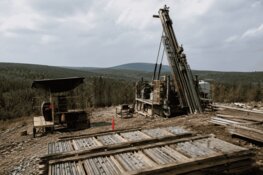
According to the company, the two core holes were drilled across a high-grade zone previously defined by reverse circulation drilling in order to provide improved confidence and context for geologic, geometric, and gold-grade models. The company stated that the two holes represent 298.4 meters of the recently completed 21,079-meter drill program.
The 2025-2026 drilling campaign included 18,683.3 meters of reverse circulation drilling and 2,395.7 meters of core drilling. West Point Gold said approximately 7,025 meters of assays remain pending and are expected to be released over the next couple of months. With drilling now complete, the company said it will focus on integrating results into its maiden mineral resource estimate, which is expected later in 2026.
"These results continue to highlight the high-grade nature of NE Tyro and the potential of this zone," stated Derek Macpherson, President and CEO, in the news release. He added that the core holes correlated well with nearby reverse circulation holes and provided confidence that the company's reverse circulation drilling practices were producing representative results.
West Point Gold said both holes targeted areas near previously defined high-grade gold mineralization. The company stated that, aside from hole GC24-034, previous drilling in the area had been completed using reverse circulation methods. The core drilling program was designed to provide detailed information regarding recovery, rock quality designation, vein styles, textures, and density to support geological and grade models at NE Tyro.
The company reported that both holes intersected the NE Tyro vein at elevations between approximately 760 and 790 meters above sea level, or about 100 meters below surface. West Point Gold described the NE Tyro vein as a structure dipping southeast at approximately 70 to 75 degrees and ranging from 15 to 25 meters in width. The company said the host rocks include Precambrian granite along with lenses of gneiss, schist, and amphibolite.
West Point Gold also reported observations of multi-stage quartz-chalcedony-calcite-adularia veining and breccia, with native gold identified in drill core from hole GC26-137. The company stated that documentation of these geological features may assist its ongoing evaluation of gold deposition within the system.
Official-Sector Buying and Physical Market Shifts Continue to Shape Gold Trade
Recent reporting highlighted continued gold accumulation by central banks even as bullion prices experienced a third consecutive monthly decline. According to a June 8 analysis by GoldFix citing Bloomberg data, the People's Bank of China added approximately 320,000 troy ounces of gold to its reserves during May, equivalent to roughly 9.9 tonnes. The purchase marked the nineteenth consecutive month of reported additions, bringing China's declared gold holdings to about 2,322 tonnes.
GoldFix also reported that China's net gold imports reached 316 tonnes during the first quarter, more than three times the volume recorded during the same period of the previous year. At the same time, World Gold Council data cited by the publication showed lower withdrawals from the Shanghai Gold Exchange as jewelry demand entered its seasonal slowdown.
The publication further referenced commentary from Goldman Sachs Group Inc., which stated that central-bank gold purchases could increase as geopolitical developments encourage reserve diversification. GoldFix wrote that continued buying by official institutions remained a source of support for gold demand despite recent weakness in prices.
Meanwhile, Reuters reported on June 9 that India's decision to raise gold import tariffs to 15% in May had contributed to a rise in smuggling activity. Industry officials and bullion dealers cited by Reuters said the higher tariff created a pricing advantage for illegal imports, allowing smugglers to undercut legitimate suppliers.
According to Reuters, discounts in the grey market exceeded US$200 per ounce following the tariff increase, and illegal imports could exceed 100 metric tons during 2026. The report noted that India is the world's second-largest gold market after China and that the tariff increase was introduced as part of efforts to reduce demand, narrow the trade deficit, and ease pressure on the rupee. Market participants cited by Reuters said the higher duties had altered trading conditions within the country's physical gold market.
A separate analysis published by GoldFix on June 9 examined gold's performance relative to U.S. equities over the long term. Citing research from Datatrek, the publication reported that gold's historical performance has been characterized by periods of strong outperformance followed by extended consolidation phases.
According to GoldFix, Datatrek reviewed rolling one-year performance comparisons between gold and the S&P 500 dating back to 2006 and found that gold had generally outperformed U.S. equities over the longer term, although much of that advantage was generated during concentrated periods rather than through steady gains.
The publication wrote that recent weakness in gold prices had not materially changed the broader historical pattern. Datatrek stated that gold's previous gains relative to equities may have created an environment in which stocks were able to narrow the performance gap following the metal's recent advance.
Analyst Reviews Drilling and Metallurgical Work at Gold Chain
In an April 24 research note, Red Cloud Securities analyst Ron Stewart highlighted recent drilling results from the Tyro Main zone at West Point Gold's Gold Chain project in Arizona, noting that the latest holes continued to define mineralization across the deposit area.
Stewart wrote that the drill program focused on the central and southern portions of the Tyro Main zone, which forms part of a 3.4-kilometer northeast-southwest trending low-sulfidation epithermal system. According to the analyst, all of the reported holes intersected mineralization.
Among the reported intercepts, hole GC26-125 returned 184.4 meters grading 1.0 g/t gold, including 10.7 meters grading 8.11 g/t gold. Stewart noted that the hole delivered the longest mineralized interval reported from the project to date. Other results included 22.9 meters grading 3.11 g/t gold in hole GC26-116 and 88.6 meters grading 0.8 g/t gold in hole GC26-127.
The analyst stated that the results continued to support the continuity of mineralization throughout the Tyro Main zone while further defining the interpreted geometry of the vein system. He noted that hole GC26-125 was drilled parallel to the mineralized structure and intersected continuous veins and veinlets, while nearby hole GC26-127, drilled at a slightly different orientation, returned comparable mineralization. Hole GC26-116 was designed to test the full width of the mineralized zone.
Stewart also reviewed the Phase 2 metallurgical test work released on April 22. The testing indicated that ultra-fine grinding produced the strongest recovery results for the finely disseminated gold mineralization. Material ground to 0.075 millimeters achieved gold recoveries ranging from 87% to 92%, while silver recoveries ranged from 55% to 83%. By comparison, high-pressure grinding roll material sized to 6.2 millimeters and conventionally ground material sized to 12.5 millimeters generated lower recoveries following 168 hours of leaching. Stewart wrote that additional metallurgical work and optimization could further evaluate recovery performance.
The analyst said the results arrived as the company advanced toward its planned maiden Mineral Resource Estimate. According to Stewart, mineralization within the Tyro vein system had been traced over approximately 1.4 kilometers, with higher-grade concentrations occurring toward the northeastern portion of the zone. He added that 94 drill holes completed within the Tyro Main zone had returned an average intercept of 28.2 meters grading 2.24 g/t gold.
At the time of the report, Stewart noted that West Point Gold had completed 16,504 meters of a planned 20,000-meter drill campaign, while assay results remained pending from an additional 24 holes.
Stewart said Red Cloud Securities had not assigned a rating or target price to the company. He identified the maiden Mineral Resource Estimate for the Tyro Main zone and the receipt of drill permits at Jefferson Canyon, both anticipated in 2026, as upcoming milestones.
Separately, Bob Moriarty of 321gold.com commented on the company's exploration activities, stating that West Point Gold continued to advance the Gold Chain project "one hole after another with their fully funded 20,000-meter drill program."
Moriarty added, "With CA$30 million in their treasury, look for fireworks when they announce their pending 43-101 resource in 2026."
Resource Work and Project Programs Continue
West Point Gold said approximately 7,025 meters of assay results remain pending from the completed 21,079-meter drilling campaign and are expected to be released over the next couple of months. Following completion of drilling, the company said it is focused on incorporating results from the program into a maiden mineral resource estimate planned for release later in 2026.
 Streetwise Ownership Overview*
West Point Gold Corp. (WPG:TSXV; WPGCF:OTCQX)
| Date | Old Symbol | Old Shares | New Symbol | New Shares |
|---|---|---|---|---|
| 12/23/24 | AUU:TSXV | 1 | WPG:TSXV | 1 |
| 04/22/24 | AUU:TSXV | 10 | AUU:TSXV | 1 |
| 11/30/18 | AUU:TSXV | 5 | AUU:TSXV | 1 |
| 08/25/98 | AMI:TSXV | 10 | AUU:TSXV | 1 |
According to the company's June 2026 investor presentation, the Gold Chain project remains the focus of a 20,000-meter drill program and the planned maiden resource estimate. The presentation also outlined ongoing work across the company's Nevada projects. At Jefferson Canyon, permitting activities are advancing for an initial drill program under an exploration and option agreement with Kinross. The presentation states that Kinross is required to spend US$600,000 on exploration work and is responsible for maintaining the claims in good standing.
The presentation further states that Baxter Spring, an advanced-stage exploration project in Nye County, Nevada, is undergoing data compilation, geological modeling, integrated geochemical and structural interpretation, and permitting for a planned 5,000-meter drill program in 2026. Historical work at Baxter Spring includes 128 drill holes totaling approximately 13,000 meters.
West Point Gold's investor presentation also notes estimated working capital of approximately CA$27.8 million as of March 31, 2026, and identifies additional in-the-money warrants valued at approximately CA$9.9 million.
Ownership and Share Information1
West Point Gold Corp. has a market cap of CA$176.12 million, with 135.48 million shares outstanding. The company's 52-week range is CA$0.29 to CA$2.17.
Management and insiders own about 6.3% of shares, while about 25.7% of shares are held by institutions. The rest is retail.
| Want to be the first to know about interesting Gold investment ideas? Sign up to receive the FREE Streetwise Reports' newsletter. | Subscribe |
Important Disclosures:
- As of the date of this article, officers, contractors, shareholders, and/or employees of Streetwise Reports LLC (including members of their household) own securities of West Point Gold Corp.
- James Guttman wrote this article for Streetwise Reports LLC and provides services to Streetwise Reports as an employee.
- This article does not constitute investment advice and is not a solicitation for any investment. Streetwise Reports does not render general or specific investment advice and the information on Streetwise Reports should not be considered a recommendation to buy or sell any security. Each reader is encouraged to consult with his or her personal financial adviser and perform their own comprehensive investment research. By opening this page, each reader accepts and agrees to Streetwise Reports' terms of use and full legal disclaimer. Streetwise Reports does not endorse or recommend the business, products, services or securities of any company.
For additional disclosures, please click here.
1. Ownership and Share Structure Information
The information listed above was updated on the date this article was published and was compiled from information from the company and various other data providers