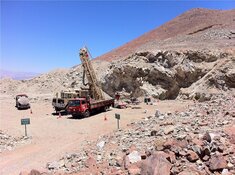


West Point Gold Corp. (WPG:TSXV; WPGCF:OTCQX) reported results from its property-wide target testing program at the Gold Chain project, including initial drilling results from the Union Pass Fault corridor at the Bull 8 target. The company said the program returned significant gold values highlighted by a 21.4-meter interval grading 1.01 grams per tonne (g/t) gold.
According to the company, the Bull 8 target is located approximately six kilometers northwest of the Tyro zone and lies outside the area being incorporated into its upcoming maiden mineral resource estimate.
The Union Pass Fault is described as a major regional structural feature with several associated faults mapped and sampled along its 12-kilometer strike length on the property. Initial drilling within the corridor focused on Bull 8, where historical prospect pits and trenches are present. The company stated that surface mapping and sampling identified a broad northwest-trending zone of prospective mineralization, including gold-bearing structures that returned values greater than 2 g/t gold.
West Point Gold completed six drill holes totaling 855.7 meters at Bull 8. Hole GC26-136 returned 21.4 meters grading 1.01 g/t gold from 71.6 meters to 93.0 meters within a broadly mineralized envelope. The company reported that the interval represented an estimated true width of 18 meters. Hole GC26-130 returned 12.2 meters grading 0.41 g/t gold from 6.1 meters to 18.3 meters, identifying what the company described as an extensive near-surface lower-grade zone.
The company stated that all holes drilled across the Bull 8 prospect intersected gold mineralization. It also reported that extensive quartz veining, hydrothermal alteration, and anomalous gold values can be observed throughout the 12-kilometer Union Pass Fault corridor.
"The significance of the results in GC26-136 has less to do with the significant gold values intersected and more to do with the structural setting," stated Derek Macpherson, president and chief executive officer. "The Union Pass Fault corridor, and the associated Frisco mine fault, are major regional structural features with approximately 12 km of demonstrated strike length on Gold Chain. Exploration success at Bull 8 supports the company's view that these major features, which also control the Frisco graben, appear to have played an important role in the mineralizing events at Gold Chain."
The company said hole GC26-136 was the deepest hole drilled during the campaign and encountered gold grades of up to 5.96 g/t gold within the broader interval. Approximately 50 meters higher in the system, hole GC26-132 returned 7.62 meters grading 0.35 g/t gold at the hanging wall contact and 9.14 meters grading 0.22 g/t gold along the footwall.
West Point Gold reported that 20,116 meters of its continuing drill program at the Gold Chain project have been completed to date. Assay results remain pending from the Black Dyke, Tyro Main, and NE Tyro zones, representing 35 holes totaling 7,697 meters.
Central Banks, Market Forces Keep Gold in Focus
Gold continued to play a prominent role in global reserve management as central banks maintained significant bullion holdings and prices remained near historic highs. According to the June 2 edition of Rocks Daily by Red Cloud Securities, central banks collectively held more than 36,000 tonnes of gold, with reserves approaching levels not seen since the Bretton Woods era. The publication reported that gold had overtaken U.S. Treasuries as the world's second-largest reserve asset as countries continued efforts to diversify reserve holdings.
Additional data released by the European Central Bank and cited in a June 2 Telegraph report reflected the metal's growing presence in reserve portfolios. The report stated that gold accounted for 27% of central bank foreign reserve holdings in 2025, surpassing the 22% share held in U.S. Treasuries. According to the European Central Bank, central banks continued to regard gold as an important balance-sheet asset amid geopolitical uncertainty. The report also noted that 70% of central banks surveyed in April identified geopolitics as the most significant risk facing them during the year. While annual central bank purchases declined to 850 tonnes in 2025 from more than 1,000 tonnes in each of the previous three years, higher gold prices increased the metal's overall share of global reserve holdings.
Commentary from market participants also reflected ongoing interest in precious metals. In a June 2 analysis, Stewart Thomson described gold as moving through a consolidation period following what he characterized as strong performance against fiat currencies during 2024 and 2025. Thomson wrote that "Gold price consolidations are healthy," and suggested that periods of sideways trading can shift attention toward gold's broader role within the monetary system. He also stated that "Professional gold and silver bugs are focused less on what's next for the price, and instead on getting more metal."
Thomson also discussed sentiment within the mining sector, writing that "Gold and silver miners seem ready to again showcase their greatness, with a fresh move to the high end of their range!" He noted that mining-focused exchange-traded funds and their underlying holdings continued to offer exposure to the precious metals sector. Collectively, the reports highlighted continued central bank demand for gold, shifting reserve allocation patterns, and sustained market attention on precious metals.
At the same time, precious metals prices faced pressure from broader macroeconomic and geopolitical developments. According to a June 3 report from Kitco, gold and silver prices moved lower as higher crude oil prices, rising U.S. Treasury yields, and renewed military conflict between the United States and Iran weighed on the sector. Spot gold traded near US$4,432.60 per ounce, down 1.24% on the session, while spot silver traded near US$72.76 per ounce, down 3.17%.
On June 3, Kitco reported that oil prices advanced for a third straight session, with WTI crude settling at US$96.02 per barrel and Brent crude at US$97.81 per barrel amid concerns about potential disruptions to shipping through the Strait of Hormuz. The publication noted that while geopolitical tensions continued to support defensive demand for gold, stronger energy prices, a firmer U.S. dollar, and higher Treasury yields created headwinds for non-yielding assets.
Kitco also reported that U.S. equity markets declined as investors reacted to rising energy costs, higher yields, and increasing uncertainty surrounding developments in the Middle East.
Analyst Highlights Resource Progress and Metallurgical Results at Gold Chain
According to an updated research note from Red Cloud Securities analyst Ron Stewart dated April 24, recent drilling at the Tyro Main zone continued to demonstrate the scale and continuity of mineralization within the Gold Chain project. Stewart noted that the holes targeted the central and southern portions of the Tyro Main zone, part of a 3.4-kilometer northeast-southwest trending low-sulfidation epithermal system, and that every hole intersected mineralization.
Among the results, Stewart highlighted hole GC26-125, which returned 1.0 g/t gold over 184.4 meters, including 8.11 g/t gold over 10.7 meters. He noted that the intercept represented the longest mineralized interval encountered at the project to date. Additional results included 3.11 g/t gold over 22.9 meters in hole GC26-116 and 0.8 g/t gold over 88.6 meters in hole GC26-127. Stewart wrote that the results supported the continuity of mineralization throughout the Tyro Main zone and reinforced the interpreted vein geometry across the deposit area.
The analyst noted that hole GC26-125 was drilled parallel to the Tyro Main zone and intersected continuous veins and veinlets, while hole GC26-127, drilled nearby and slightly perpendicular to GC26-125, returned comparable mineralization. Hole GC26-116 was designed to test across the full width of the zone.
Stewart also discussed Phase 2 metallurgical test work released on April 22, which indicated that ultra-fine grinding was required to efficiently recover the finely disseminated gold mineralization. According to the results, material ground to 0.075 millimeters achieved gold recoveries ranging from 87% to 92%, while silver recoveries ranged from 55% to 83%. In contrast, high-pressure grinding roll material sized to 6.2 millimeters and conventionally ground material sized to 12.5 millimeters delivered substantially lower recoveries after 168 hours of leaching. Stewart wrote that the results suggested additional metallurgical testing and optimization could further improve recoveries.
The analyst stated that the drilling results were encouraging in advance of the company's planned maiden Mineral Resource Estimate. He noted that mineralization within the Tyro vein system had been traced for approximately 1.4 kilometers, with higher-grade concentrations identified toward the northeastern portion of the zone. Stewart added that 94 drill holes completed within the Tyro Main zone had returned an average grade of 2.24 g/t gold over 28.2 meters.
At the time of the report, Stewart noted that the company had completed 16,504 meters of its planned 20,000-meter drill campaign, with assay results pending from an additional 24 holes.
Stewart stated that West Point Gold had not yet been assigned a rating or target price by Red Cloud Securities. He identified the planned maiden resource estimate for the Tyro Main zone and the receipt of drill permits at Jefferson Canyon, both expected in 2026, as key upcoming milestones.
Separately, Bob Moriarty of 321gold.com commented on the company's ongoing exploration efforts, stating that West Point continued to advance Gold Chain "one hole after another with their fully funded 20,000-meter drill program."
Moriarty added, "With CA$30 million in their treasury, look for fireworks when they announce their pending 43-101 resource in 2026."
Resource Work and Project Programs Remain Underway
According to the company's June 2026 investor presentation, a maiden resource estimate at the Gold Chain project is targeted for 2026. The presentation noted that the company is conducting an ongoing 20,000-meter drill program at Gold Chain and identified the maiden resource estimate as one of its upcoming catalysts.
 Streetwise Ownership Overview*
West Point Gold Corp. (WPG:TSXV; WPGCF:OTCQX)
| Date | Old Symbol | Old Shares | New Symbol | New Shares |
|---|---|---|---|---|
| 12/23/24 | AUU:TSXV | 1 | WPG:TSXV | 1 |
| 04/22/24 | AUU:TSXV | 10 | AUU:TSXV | 1 |
| 11/30/18 | AUU:TSXV | 5 | AUU:TSXV | 1 |
| 08/25/98 | AMI:TSXV | 10 | AUU:TSXV | 1 |
The presentation stated that the Tyro Main Zone remains the primary resource area and that a maiden resource drill program is underway along the approximately 3.4-kilometer Tyro vein system. The company also highlighted near-term step-out drilling targets at Black Dyke and Sheep Trail, where recent drilling has returned gold intercepts from near-surface mineralization.
Outside Arizona, the company outlined work programs at its Nevada assets. At Jefferson Canyon, West Point Gold reported that permitting activities are being advanced under an exploration and option agreement with Kinross. At Baxter Spring, the company stated it is conducting data compilation, geological modeling, and integrated geochemical and structural interpretation work while permitting a 5,000-meter drill program planned for 2026.
The investor presentation also stated that the company had approximately US$27.8 million in working capital as of March 31, 2026, and identified additional in-the-money warrants with an estimated value of approximately US$9.9 million.
Ownership and Share Information1
West Point Gold Corp. has a market cap of CA$176.12 million, with 135.48 million shares outstanding. The company's 52-week range is CA$0.29 to CA$2.17.
Management and insiders own about 6.3% of shares, while about 25.7% of shares are held by institutions. The rest is retail.
| Want to be the first to know about interesting Gold investment ideas? Sign up to receive the FREE Streetwise Reports' newsletter. | Subscribe |
Important Disclosures:
- As of the date of this article, officers, contractors, shareholders, and/or employees of Streetwise Reports LLC (including members of their household) own securities of West Point Gold Corp.
- James Guttman wrote this article for Streetwise Reports LLC and provides services to Streetwise Reports as an employee.
- This article does not constitute investment advice and is not a solicitation for any investment. Streetwise Reports does not render general or specific investment advice and the information on Streetwise Reports should not be considered a recommendation to buy or sell any security. Each reader is encouraged to consult with his or her personal financial adviser and perform their own comprehensive investment research. By opening this page, each reader accepts and agrees to Streetwise Reports' terms of use and full legal disclaimer. Streetwise Reports does not endorse or recommend the business, products, services or securities of any company.
For additional disclosures, please click here.
1. Ownership and Share Structure Information
The information listed above was updated on the date this article was published and was compiled from information from the company and various other data providers