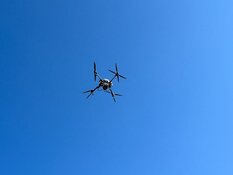


With an increasing number of commercial applications, rising geopolitical tensions, and defense budgets fueling initiatives and use by the military and expansion in counter-unmanned aerial systems (C-UAS), the world's entire drone ecosystem is evolving and growing quickly. It is projected to more than double in size between this year and 2030, reaching US$163 billion (US$163B) from US$73B and reflecting a 14.3% compound annual growth rate (CAGR), according to Grand View Research.
"This growth is largely driven by rapid advancements in drone technology, improvements in battery efficiency, artificial intelligence (AI)-powered autonomous systems, and enhanced imaging sensors, which are further expanding the capabilities of drones across industries," the report said.
Commercial to See 37% CAGR
Of the defense, commercial, and counter-drone sectors, commercial is projected to expand the most in the next five to 10 years, at a remarkable 37% CAGR between this year and 2035, according to a September 2025 Spherical Insights report. This growth would take the market size to an estimated US$993B from US$31B. During the forecast period, North America is expected to generate the highest demand, and the Asia Pacific is expected to grow the fastest.
Drone manufacturers are continually experimenting, developing, and improving solutions for a range of markets and uses. As such, unmanned aerial vehicles (UAVs) are being used increasingly in more and more diverse industries, including logistics, construction, energy, agriculture, delivery, and transportation (air taxis). Regarding drone taxis, EHang Holdings Ltd. (EH:NASDAQ), an urban air mobility company, successfully completed a series of trial flights, transporting people from point to point in Doha, Qatar, using its EH216-S pilotless electric vertical takeoff and landing (eVTOL) aircraft.
A rapidly emerging business model in the commercial drone sector is drone-as-a-service. With DaaS, according to Unmanned Systems Technology, companies provide drone technology and drone services to customers on a subscription or pay-per-use basis, affording them access to aerial data collection, mapping, photography, security surveillance, precision surveying, monitoring, and other drone-based solutions without having to own and operate the technology themselves.
"The DaaS industry outlook is extraordinarily strong, marked by rapid growth, increasing adoption across diverse industries, and significant technological advancements like AI integration," noted a Nov. 13 news release. "The market is projected to reach substantial values in the coming years, driven by the cost-effectiveness and efficiency of outsourced drone services."
There have been many DaaS-related transactions in the U.S. in recent months, consistent with the projected 29.7% CAGR for the sector through 2029. On Nov. 20, for instance, ZenaTech (ZENA:NASDAQ) agreed to acquire a Utah-based surveying and three-dimensional (3D) mapping company specializing in LiDAR processing, drone-enabled data capture, and large-scale solar site development clients.
ZenaTech specializes in DaaS, AI drone, enterprise software-as-a-service, and quantum computing solutions, and this transaction marks its strategic entry into the solar infrastructure market. On Nov. 17, Valqari, a hardware start-up providing autonomous logistics solutions for UAVs, acquired the patent portfolio of Skydrop, a pioneer in drone delivery.
In the U.S., the Federal Aviation Administration (FAA) is in the process of officially revising its criteria for Beyond Visual Line of Sight (BVLOS) operations to allow commercial drones to fly extended distances with better safety oversight. The FAA developed and published a proposed rule for this, and the period for public comment ended in October, Lexology reported. After reviewing the feedback, the agency will publish a final rule, the original timeline for which is March–April 2026. This date may be pushed back, however, due to the volume and substance of the thousands of comments received. Finalization of the rule will be critical for large-scale applications, for example, in last-mile delivery, mapping, infrastructure monitoring, and precision agriculture, as it allows drones to cover more area.
"Companies that align early with BVLOS standards will secure first-mover advantages and set new benchmarks for operational efficiency," according to a September 2025 Research and Markets report on U.S. drone market trends.
Another significant near-term change is the imminent U.S. ban on imports and sales of all China-made commercial and consumer drones and drone components, including those by DJI (Da-Jiang Innovations), China's largest drone manufacturer, and Autel Robotics Co. Ltd., Thomas Black, a Bloomberg Opinion columnist specializing in industrial and transportation sectors, wrote on Nov. 20. The ban will go into effect by default on Jan. 1, 2026, according to the 2025 National Defense Authorization Act (NDAA), if the federal government fails to conduct a required national security risk assessment by Dec. 23.
The ban will lead to increased business opportunities for domestic manufacturers, wrote Black, but the transition will be painful for U.S. consumers and businesses currently using Chinese products. However, Black emphasized, ending the Western country's reliance on China for these products is necessary for its national security.
The U.S. is the world's second-largest drone market behind China, according to Statista. Between the ban on China-made drones, the FAA's final rule on BVLOS operations, and the U.S. military spending US$1.4M on small drones, "next year sets up as nothing short of transformational for the U.S. drone industry," wrote Black.
Tensions, Budgets Expand Military
The world's military drone sector is expected to experience a 12.1% CAGR to 2030, fueled by multiple factors, according to Research and Markets in a July 2025 report. Rising geopolitical tensions, changing defense strategies, and a growing emphasis on asymmetric warfare have led to heightened demand for UAVs as "cost-effective and versatile force multipliers."
Worldwide, defense budgets are increasing, and governments are investing heavily in drone technologies to beef up surveillance and combat capabilities and to minimize risks to personnel and operational costs. Innovations in AI, automation, and miniaturization have made drones more capable and accessible, further spurring their adoption. The emergence of new use cases, like drone swarming and integrated multidomain operations, supportive regulatory environments, and rising public-private partnerships, all contribute to the expansion of the military drone sector.
In the U.S., the Army stated it intends to buy millions of drones over the next two to three years as it ramps up its ability to internally, domestically produce low-cost small UAVs, Breaking Defense reported. Via its SkyFoundry program, the service branch aims to produce thousands of drones by next fall and eventually 1 million drones each year. To that end, the U.S. Department of War (DOW) recently released Acquisition Transformation Strategy outlined an overhaul of its current procurement systems, removing unnecessary regulations and processes, Bell Potter Analyst Kirk Bell wrote in a Nov. 1 research note.
"This initiative should see significantly increased demand for unmanned components suppliers," Kirk wrote.
Further, earlier this year, the Army also launched its Purpose-Built Attritable Systems (PBAS) initiative, designed to deliver effective, modular, and mission-adaptable first-person view (FPV) drones to all platoon-level units, and has been awarding related contracts.
Threats Ignite Countermeasures
The rising demand for and use of UAVs by the military, homeland security, and commercial sectors, along with escalating security threats by way of unauthorized drone activities, are primarily causing the growth of the counterdrone solutions sector. A 27.2% CAGR between 2025 and 2030 is forecasted, according to Grand View Research, meaning its size will more than quadruple, to US$10.6B from US$2.5B.
Continuing innovations in anti-drone technologies, including AI-driven systems and advanced sensors; increasing government and military investments; and demand for integrated systems for a multilayered approach are spurring market growth, too. The DOW is spending US$7.4B to procure counterdrone solutions in the current fiscal year, 50% more than the outlay a decade ago, according to an Oct. 6 Bloomberg Opinion piece.
Further, governments worldwide are establishing frameworks to govern drone operations while simultaneously promoting the development of countermeasures. An example of this is regulations that require airports to implement C-UAS. In November, Ondas Holdings Inc. (ONDS:NASDAQ), a U.S.-based provider of autonomous aerial and ground robot intelligence, secured a US$8.2M contract from a major European security agency to deploy Iron Drone Raider C-UAS at one of Europe's largest international airports.
Also, Ondas recently gained cyber-over-radiofrequency C-UAS technology that can detect, identify, track, and take control of hostile drones, via its recently closed acquisition of Sentry CS Ltd., an Israel-based counterdrone specialist, for about US$225M.
In November, the U.S. established a US$500M grant program to help communities "combat illegal drone use" at and around future large-scale sporting and other events, Commercial UAV News wrote on Nov. 21. The first US$250M will go to the 11 host cities of the FIFA World Cup 2026, to the Olympics and to America 250 national events in the coming years and to the U.S.' National Capital Region. The other US$250M will be distributed in 2027 to "all states and territories with an expanded focus on building national detection and response capacity," noted the press release.
New Drone-Focused ETF
In a bit of financial news, a new drone-centric exchange-traded fund (ETF), REX Drone ETF (DRNZ:NASDAQ), was launched on Oct. 29, by REX Shares, reported FOX Business. Eighty percent of DRNZ's portfolio comprises companies generating most of their revenue from drones and companies supporting the industry's technologies.
Currently, the ETF has 40 holdings, including Ondas, Red Cat Holdings Inc. (RCAT:NASDAQ), DroneShield Ltd. (DRO:ASX; DRSHF:OTC), Volatus Aerospace Inc. (TAKOF:OTCMKTS), AeroVironment Inc. (AVAV:NASDAQ), and Palantir Technologies Inc. (PLTR:NASDAQ).
Numerous companies stand to benefit from the rising demand for and growth of the drone sector. Here is a look at a handful of them:
Unusual Machines Inc.
Headquartered in Florida, U.S., Unusual Machines Inc. (UMAC:NYSEAMERICAN) is a domestic builder and supplier of drone components for enterprise and retail customers, and continues to grow both groups organically and through mergers and acquisitions.
Recently, the company invested US$25M for a potential 34% stake in XTI Aerospace Inc. (XTIA:NASDAQ), so that UMAC now holds a significant equity stake in a next-generation VTOL platform, Litchfield Hills Research Analyst Barry Sine pointed out in a Nov. 13 research report. About the same time, XTI acquired Drone Nerds, also based in Florida, for US$40M. As such, Unusual Machines is now the largest shareholder of the largest U.S. drone distributor.
 Streetwise Ownership Overview*
Unusual Machines Inc. (UMAC:NYSEAMERICAN)
"UMAC continues to evolve from a drone components manufacturer into a central node in the emerging American drone and VTOL ecosystem. This investment enhances strategic optionality, deepens vertical integration, and offers a uniquely asymmetric risk-reward profile," Sine wrote. He has a Buy rating and a target price on UMAC, suggesting 197% upside from its Nov. 25 closing price.
In a Nov. 12 research report, Needham & Co. Analyst Austin Bohlig wrote that Unusual Machines' investment in XTI was a strategic play to improve its visibility as a key drone parts supplier and improve its relationships with leading commercial drone providers. UMAC is well-positioned to achieve significant growth over the next several years, in large part due to its robust component portfolio and expected future additions to it, along with the ramp-up of its new manufacturing facility, according to Bohlig.
"We believe Unusual Machines is among the best-positioned domestic suppliers of flight-critical, NDAA-compliant components to capitalize on this reshoring trend," the analyst wrote. "With only a handful of small domestic players competing in this space, we see a clear path for the company to capture a significant amount of the estimated US$620M U.S. component market in 2026."
Bohlig's rating on UMAC is Buy, and his target price implies a 137% potential return.
1As for ownership and share structure, seven strategic entities own 6.85% of Unusual Machines, including Chief Executive Officer (CEO) and Director Allan Evans with 2.89% and Chief Financial Officer Brian Hoff with 1.33%. More than 100 institutions hold 22.7%; one of them, Tudor Investment Corp., is the largest shareholder overall, with 3.27%. Retail investors have the rest.
Unusual Machines has 36.88 million (36.88M) shares outstanding. Its market cap is US$313.07M. Its 52-week range is US$4.45–23.62 per share.
Red Cat Holdings Inc.
Headquartered in Puerto Rico, Red Cat Holdings Inc. (RCAT:NASDAQ) is a drone technology company integrating robotic hardware and software for military, government, and commercial operations. The company just released its Q3/25 financial and operational results. Highlights included record revenue of US$9.6M, up 646% year over year, and a strong cash plus accounts receivables balance of US$212.5M. The Army expanded Red Cat's contract through its SRR UAS Tranche 2 (SRR2) program, taking it to about US$35M in value. Teal in Salt Lake City, Utah, and FlightWave in Los Angeles, Calif., recently increased their manufacturing capacity through new and bigger leased facilities.
Seeking Alpha's Stone Fox Capital wrote in a Nov. 24 article that "in a wild swing," Red Cat's stock just fell sharply, thereby presenting an attractive entry point. This retreat occurred despite the company's strong momentum in the U.S. drone market, new product launches, and growth. Red Cat is expanding into uncrewed surface vessels (USVs), targeting a US$150M opportunity, and during Q3/25, opened a 155,000-square-foot facility in Georgia, allowing for the manufacturing of 500 vessels per year. However, the company lowered its 2025 revenue guidance significantly because of U.S. contract delays resulting from the government shutdown.
In an Oct. 10 research report, Needham's Bohlig highlighted the growth opportunities for Red Cat through the Army's ramp-up of its SRR2 program, through the company's commercial entry into USVs with the potential for fast tracking, and through international defense markets, including the North Atlantic Treaty Organization.
"We believe the unmanned aerial systems industry is entering a multiyear supercycle and view Red Cat as uniquely positioned to capture accelerating demand for defense-grade small intelligence, surveillance, and reconnaissance drones as the U.S. looks to restore drone dominance," Bohlig wrote. "We think the company's most significant near-term opportunity is the U.S. Army's Short Range Reconnaissance Tranche 2 (SRR2) program of record, which we view as a transformational contract for Red Cat."
Bohlig's rating on RCAT is Buy, and his target price suggests a 134% return from RCAT's Nov. 25 closing price.
1The ownership breakdown of Red Cat is 11.75% by eight strategic entities, 39.23% by more than 240 institutions, and the rest by retail investors. The largest shareholder overall is Red Cat CEO Jeffrey Thompson with 10.78%.
The company has 119.37M shares outstanding, a market cap of US$863.05M, and a 52-week range of US$4.56–16.70 per share.
DroneShield Ltd.
DroneShield Ltd. (DRO:ASX; DRSHF:OTC) is an Australian defense manufacturer providing AI-powered hardware and software counterdrone solutions designed to detect, track, and defeat threats from drones. In recent news, CEO Oleg Vornik confirmed that DroneShield is exploring options to expand into hard-defeat systems against drones, assuming a cost-effective, volumetric, and noncollateral damage solution exists, reported Defence Connect on Nov. 13. Historically, DroneShield only offered C-UAS with soft-kill capabilities like jamming. Earlier in November, the company published the white paper, "Best Practices for Counter-Drone Deployment at Civil Airports," with SRI Group, an aviation security and technology advisory firm, Streetwise Reports reported. The document is a guide to implementing practical, technology-driven frameworks to counteract drone-related disruptions for airport operators and regulatory bodies.
Streetwise Ownership Overview*
DroneShield Ltd. (DRO:ASX; DRSHF:OTC)
Bell Potter's Kirk reported in a Nov. 3 research note that DroneShield secured a AU$25.3M contract from a repeat defense end customer in a Latin American country. With its extensive experience and a large research and development team focused on detection and defeat capabilities, DroneShield boasts an increasing competitive edge. Further, the company should benefit from the heightened focus on counterdrone solutions around the world.
"We anticipate that 2026 will be a pivotal year for the global counterdrone industry, with countries expected to significantly increase spending on soft kill detection and defeat solutions," wrote Kirk. His target price on DRO implies a 165% uplift from its Nov. 25 closing price.
1Recent filings reveal that Vanguard Group has become a substantial shareholder in DroneShield, holding a 5.45% stake, Fidelity Management and Research holds approximately 7.49% and State Street Corporation holds approximately 6.38%.
Management and insiders hold 3.43%, according to the company.
DroneShield has 909.94 million outstanding shares and 897.68 M free float traded shares. Its market cap is AU$3B. Its 52-week range is AU$0.58–AU$6.70 per share.
Firestorm Labs Inc.
A private San Diego, Calif., company, Firestorm Labs, builds drones and drone parts and assembles its factory-in-a-box product for the U.S. military at its new 65,000-square-foot headquarters, reported FOX5 San Diego in September. Firestorm's 3D printers create drone components in as little as nine hours, with full assembly taking a day. The company's proprietary factory-in-a-box, called xCell, is a portable, self-contained 3D printing facility housed in two military-grade 20-foot-long shipping containers, intended for fast and cost-effective UAV and parts manufacturing near the battlefield.
Inside the microfactory, Firestorm fields a Multi-Jet Fusion production line developed in partnership with HP, that enables rapid manufacturing of the company’s growing portfolio of fixed-wing and quadrotor platforms, third-party platforms integrated with Firestorm’s avionics and software, and high-demand sustainment parts that often face prolonged OEM lead times.
According to Traxcn, Firestorm has 20 institutional investors, including New Enterprise Associates, Lockheed Martin, J.P. Morgan, Booz Allen Ventures, and Washington Harbour Partners.
Neros Inc.
Based in El Segundo, Calif., Neros is a private UAS developer and manufacturer. Its products are the Archer, an 8-inch FPV quadcopter with a 12-plus-mile range and 4.5-pound payload carrying capacity. The Archer Strike is a kinetic-enabled FPV for lethal effects at range. The Crossbow is a tactical ground control station that pairs with Archer. The Longbow is a maximum range ground control station for stationary positions.
Most recently, Neros raised US$75M in a funding round led by Sequoia Capital. Neros will use the capital to expand its industrial capacity, consolidate its domestic supply chain, and scale the production of its core products, citybiz reported on Nov. 12.
In other November news, the U.S. Army chose Neros as one of the primary manufacturers of FPV drones for its PBAS program. Neros will supply its Archer and Archer Strike drone platforms in both 5-inch and 10-inch variants, the next generation iterations of its battlefield-tested Archer 8-inch system.
Along with Sequoia Capital, Neros has two other institutional investors, Vy Capital and Interlagos, according to Tracxn, and one angel investor, Keller Rinaudo Cliffton.
| Want to be the first to know about interesting Technology investment ideas? Sign up to receive the FREE Streetwise Reports' newsletter. | Subscribe |
Important Disclosures:
- Unusual Machines Inc. is a billboard sponsor of Streetwise Reports and pays SWR a monthly sponsorship fee between US$3,000 and US$6,000.
- As of the date of this article, officers, contractors, shareholders, and/or employees of Streetwise Reports LLC (including members of their household) own securities of Red Cat Holdings Inc., Unusual Machines Inc., Firestorm, DroneShield Ltd.
- Doresa Banning wrote this article for Streetwise Reports LLC and provides services to Streetwise Reports as an independent contractor.
- This article does not constitute investment advice and is not a solicitation for any investment. Streetwise Reports does not render general or specific investment advice and the information on Streetwise Reports should not be considered a recommendation to buy or sell any security. Each reader is encouraged to consult with his or her personal financial adviser and perform their own comprehensive investment research. By opening this page, each reader accepts and agrees to Streetwise Reports' terms of use and full legal disclaimer. Streetwise Reports does not endorse or recommend the business, products, services or securities of any company.
For additional disclosures, please click here.
1.Ownership and Share Structure Information
The information listed above was updated on the date this article was published and was compiled from information from the company and various other data providers.