

NatBridge Resources Ltd. (NATB:CSE; NATBF:OTC; GI80:FSE) announced a new partnership with NatGold Digital Ltd. to tokenize the underground mineral rights for land parcels 45 and 46 within the Cahuilla Gold Project in Imperial County, California, according to a November 17 release.
This agreement is contingent upon NatGold Digital completing its due diligence, internal certification, and title transfer. This deal allows NatGold Digital to begin its proprietary digital mining process, a crucial initial step in transforming the project's mineral resources into NatGold Tokens — a new way of purchasing gold assets while they remain in the ground, saving money on storage and preserving the environment.
"Gold is the one metal that has value while it's still in the ground," Stephen Moses, chief executive officer of NatBridge Resources Ltd., told Streetwise Reports.
Silver of course also has value, he said, but there are fewer ingots and it also has important industrial uses that require it to be mined.
"That's why the metal that's been chosen for tokenization is gold," Moses said. "Because roughly half of the gold that is extracted from the ground is melted into ingots and put back into a vault."
As the company says on its website, "You don’t need to mine gold to monetize it anymore."
NatBridge Executive Chair Michelle Ash noted, "Having spent decades in the global mining industry, including my work as chief innovation officer at Barrick Gold, I’ve focused on how digital mining can offer a complementary alternative to traditional extraction — one that strengthens the industry while easing pressure on the environment. In this context, NatBridge's work with NatGold Digital represents an important early step in applying these concepts, contributing to the natural evolution of how the sector may recognize and realize gold's value."
Under the NatGold Resource Certification and Tokenization Agreement, signed in November, NatBridge will receive 73% of the gross proceeds from token sales, minus a 15% market liquidity fee and related network and custody expenses. NatBridge will receive monthly distributions in line with NatGold Digital’s established tokenization and market-making protocols. NatGold Digital plans to start issuing tokens in Q1 2026.
"This agreement marks the first project we present to NatGold Digital for tokenization," Moses said. "It's a key milestone toward our goal of transforming our technically compliant gold resources into tradable digital assets as a Premier NatGold Miner™ and creating liquidity and long-term value for shareholders."
According to a 2021National Instrument 43-101 technical report, parcels 45 and 46 contain approximately 12,290,139 tonnes with a total of 122,211 ounces of indicated gold resources and 6,650 ounces of inferred gold resources at a 0.005 oz/ton cutoff grade, Natbridge said.
Thousands Ready to Purchase
Using NatGold Digital’s proprietary tokenization ratios for indicated resources (0.40 of a NatGold Token per ounce/indicated and 0.20 per ounce/inferred), this equates to roughly 50,214 NatGold Tokens, with the final count subject to NatGold Digital’s tokenization protocols.
"Our collaboration with NatBridge is an important step in advancing NatGold Digital's digital mining framework from concept to application," said NatGold Digital Chief Executive Officer Andrés Fernandez Acosta. "This agreement begins the process of evaluating the project's qualification for tokenization, with the expectation that it will be the first to enter the NatGold Tokenization Queue ahead of our planned token issue in Q1 2026 — setting the model for future gold resource partnerships."
According to NatGold Digital's website, as of October 23, a total of 10,526 individuals from 157 countries have reserved 80,135 NatGold Tokens for pre-market trading — representing more than US$205 million in gross demand based on the Baseline Intrinsic Value of US$2,567 at that time.
The transaction follows NatBridge’s previous agreement with Teras Resources Ltd. USA, where NatBridge acquired the mineral rights to these parcels. Teras will receive final payment upon the successful completion of the NatGold Token issuance and sale, with proceeds derived from NatGold Digital’s monetization of these resources through its digital mining framework. The total purchase price of the mineral rights for Phase 1 is US$2.75 million, of which US$50,000 was paid after completion of NatBridge’s initial due diligence and US$277,500 is due in December, for a total payable pre-tokenization and pre-token sales of US$327,500. NatBridge will essentially "put up US$320,000 to control US$80 million," Moses said.
NatBridge is also negotiating with the project's vendor, Teras, for additional titles in Phase 2, which include resources of approximately 50,702,466 tonnes containing 596,535 ounces of indicated gold at a 0.005 oz/ton cutoff grade.
NatBridge will distribute 250,000 common shares to NatGold IP Holdings LLC at an assigned value of $0.20 per share, in relation to the company's ongoing use of the trademarked designation Premier NatGold Miner™. This issuance signifies the ongoing strategic partnership between the two entities and is distinct from the Cahuilla Gold Project title transfer and tokenization agreement mentioned in this announcement.
The issuance of the common shares is contingent upon approval from the Canadian Securities Exchange and applicable resale restrictions and will be subject to a hold period of four months and one day.
The Phase 1 transaction is the first implementation of the Collaborative Development Agreement between NatBridge and NatGold Digital, signed in January 2025. This agreement gives NatBridge exclusive rights to supply mineral rights titles for the creation of the first 2.5 million NatGold Tokens and ensures NatBridge has five-year priority supply and queuing rights for qualifying properties submitted for tokenization.
Technical Analyst Gives Targets
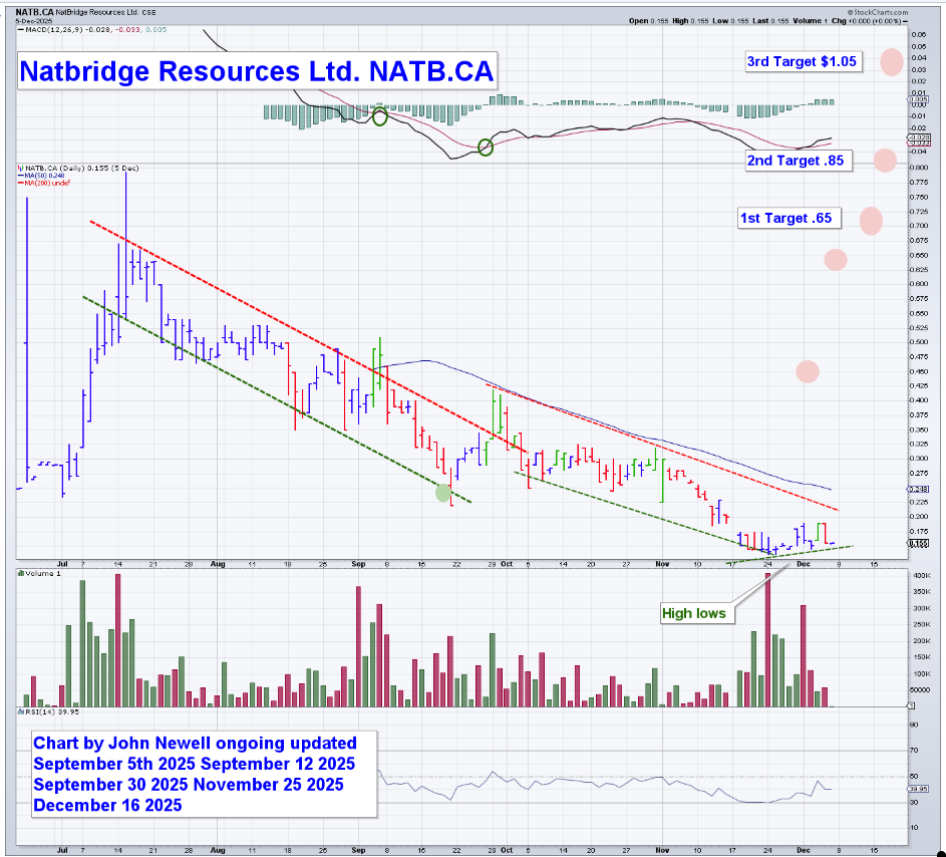
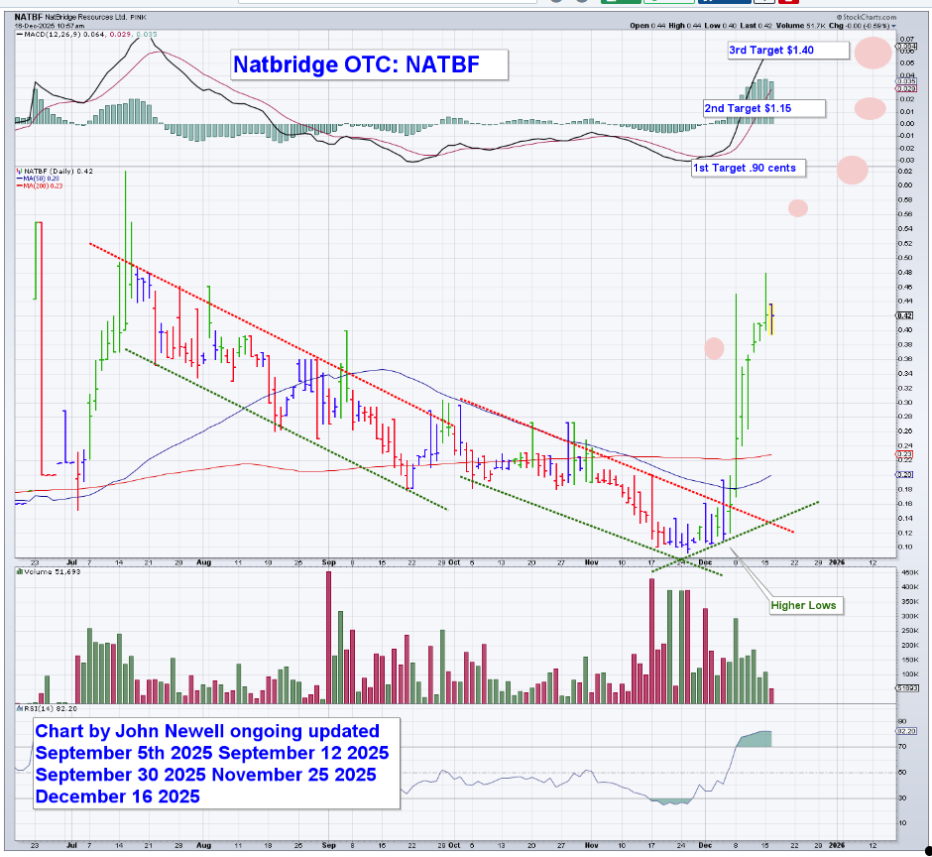
Technical analyst John Newell of John Newell and Associates told Streetwise he has set three price targets for NATB: CA$0.65, CA$0.85, and CA$1.05 (see charts at left).
On November 18, TipRanks commented on NatBridge's deal with Teras, "This move is part of a broader strategy to create liquidity and long-term value for shareholders, and it represents the first application of a collaborative agreement between NatBridge and NatGold Digital."
The stock was CA$0.155 per share on December 4, when the British Columbia Securities Commission suspended trading of the company's securities until the company files a National Instrument 43-101 Standards of Disclosure for Mineral Projects technical report to support the mineral resource disclosures initially announced by the company for parcels 45 and 46 of the Cahuilla project. The company said it was actively working the BCSC to prioritize completion of the report.
'The Gold Is Heavy'
"Underground gold" has long been prized for its luster and its use in jewelry, making it a valuable commodity that has served as currency for millennia, according to an opinion piece by Bloomberg's Matt Levine on November 25.
Initially, gold was used in coins, and later, paper money was backed by gold reserves. Today, gold remains a crucial reserve asset, with individuals holding it in their financial portfolios through gold futures, exchange-traded funds (ETFs), and other instruments.
"A lot of gold sits in vaults underground. If you buy gold reserves or futures or ETFs, you get entries in a database entitling you to some of that gold underground," Levine wrote. "There is a whole financial system built on moving gold around in which the gold doesn’t actually move. The gold is heavy. Just the electronic database entries move. The gold sits there. Its shininess is abstract and potential; it is dark in the vaults."
In the realm of "abstract commodity space," global warehouses store commodities to support futures trading, Levine noted. Financial market participants trade warehouse receipts — electronic records entitling them to the commodities in these warehouses — without necessarily moving the actual goods. For instance, JPMorgan Chase & Co. once owned nickel stored in a warehouse, which turned out to be bags of rocks. Until this was discovered, the trades functioned as if the nickel were genuine.
"There is a lot of gold in vaults underground, but there is also a lot of gold in gold mines underground," Levine wrote. "There are places on Earth with a lot of rocks that have gold in them, and with modern science you can make reasonably confident estimates of how much gold there is under your particular parcel. If gold is valuable, why is this gold still underground? Sometimes the answer is that no one knows it’s there; sometimes the answer is that it is under an active gold mine and they’re getting to it. But often the answer is that mining it is uneconomical: The gold is mixed with a lot of rock, and the cost of digging up all the rock and refining out the gold would be more than you’d get from selling the gold."
According to Moses, another consideration is the Environmental, Social, and Governance (ESG) consideration, as removing the gold from the ground can create pollution and damage the environment. That is the part that translates into demand for tokens, he said.
A Growing Appetite for Tokenized Bullion
The global tokenization market size was valued at US$2.3 billion in 2021 and is projected to reach US$5.6 billion by the end of 2026 at a CAGR of 19% during the forecast period, according to Markets and Markets.
According to Yahoo Finance Senior Business Report Ines Ferré no November 2, gold's rise to all-time highs this year has sparked a growing appetite for tokenized bullion as investors look for ways to take part in the "debasement trade," but on blockchain.
"The precious metal issued in token form uses the same technology that underpins cryptocurrencies, with issuer guarantees that the tokens are backed by physical gold securely held and designed to closely mirror the price of gold," she wrote.
As gold reached new peaks in October, stablecoin issuer Tether experienced a significant increase of up to 60% in the value of its gold tokens (XAUT), according to the article. Tether reported that the market capitalization of XAUT rose from US$1.44 billion at the close of the previous quarter to nearly US$2.1 billion last month, just before the gold sell-off.
According to a December 17 piece by Anthony Milewski for Fast Company, the past decade introduced us to cryptocurrency, which has fundamentally altered our perception of money and settlement processes. Now, we are on the brink of the next significant transformation — tokenization.
"Digital wallets, which are already routine for many of us, are paving the way," Milewski wrote. "Bank of America recently reported that by 2026, more than 5.3 billion people will use digital wallets — over half of the global population. That sheer scale is why I see wallets not just as a payment convenience, but as the infrastructure layer for tokenized assets, including commodities and equities.
The pandemic "accelerated a shift that has been building for years," he said.
Consumers who once hesitated to adopt digital payments began embracing wallets. Now, nearly 90% of smartphone users send or receive money through wallet-enabled apps, according to Bank of America.
 Streetwise Ownership Overview*
NatBridge Resources Ltd. (NATB:CSE; NATBF:OTC; GI80:FSE)
Tokenization is at the heart of this technology, he said. Digital wallets use secure aliases, or tokens, instead of sensitive account numbers. This same process, which currently makes paying for coffee more secure, will soon facilitate tokenized assets, "whether that’s a share of stock, gold, a carbon credit, or a royalty or stream."
According to Bloomberg's Levine, people who want digital tokens representing a certain amount of gold "is, in the abstract, a huge market."
"Central banks that keep gold reserves at the Fed or the Bank of England, gold futures traders, investors in gold ETFs: They all spend many billions of dollars on digital tokens representing a certain amount of gold underground," he wrote. "The NatBridge tokens are just, you know, gold in a slightly different part of underground."
Ownership and Share Structure1
NatBridge Resources has 29% ownership by management and insiders. The rest is retail.
As of October 22, 2025, NatBridge Resources Ltd. had approximately 60.43 million shares outstanding with 45.82 million free float traded shares, a market capitalization of about CA$9.39 million, and a 52-week trading range between CA$0.12 and CA$0.80.
| Want to be the first to know about interesting Special Situations, Gold and Technology investment ideas? Sign up to receive the FREE Streetwise Reports' newsletter. | Subscribe |
Important Disclosures:
- NatBridge Resources Ltd. is a billboard sponsor of Streetwise Reports and pays SWR a monthly sponsorship fee between US$3,000 and US$6,000.
- As of the date of this article, officers, contractors, shareholders, and/or employees of Streetwise Reports LLC (including members of their household) own securities of NatBridge Resources Ltd.
- Steve Sobek wrote this article for Streetwise Reports LLC and provides services to Streetwise Reports as an employee.
- This article does not constitute investment advice and is not a solicitation for any investment. Streetwise Reports does not render general or specific investment advice and the information on Streetwise Reports should not be considered a recommendation to buy or sell any security. Each reader is encouraged to consult with his or her personal financial adviser and perform their own comprehensive investment research. By opening this page, each reader accepts and agrees to Streetwise Reports' terms of use and full legal disclaimer. Streetwise Reports does not endorse or recommend the business, products, services or securities of any company.
For additional disclosures, please click here.
- Ownership and Share Structure Information
The information listed above was updated on the date this article was published and was compiled from information from the company and various other data providers.